
REGULAR BREAST SCREENING IS IMPORTANT
From October 8, 2024, the Ontario Breast Screening Program (OBSP) expands the screening program to people ages 40 to 49. This means that Ontarians (women, Two-Spirit people, trans people, nonbinary people and women with breast implants) can begin routine breast screening (Mammograms) without a referral between the ages of 40 and 74 if they:

Patient Information
Mammography is a specific type of imaging that uses a low-dose x-ray system for examination of the breasts. Most medical experts agree that successful treatment of breast cancer often is linked to early diagnosis. Mammography plays a central part in early detection of breast cancers because it can show changes in the breast up to two years before a patient or physician can feel them.
Most people in this age group who decide to get screened for breast cancer should get screened with mammography every 2 years
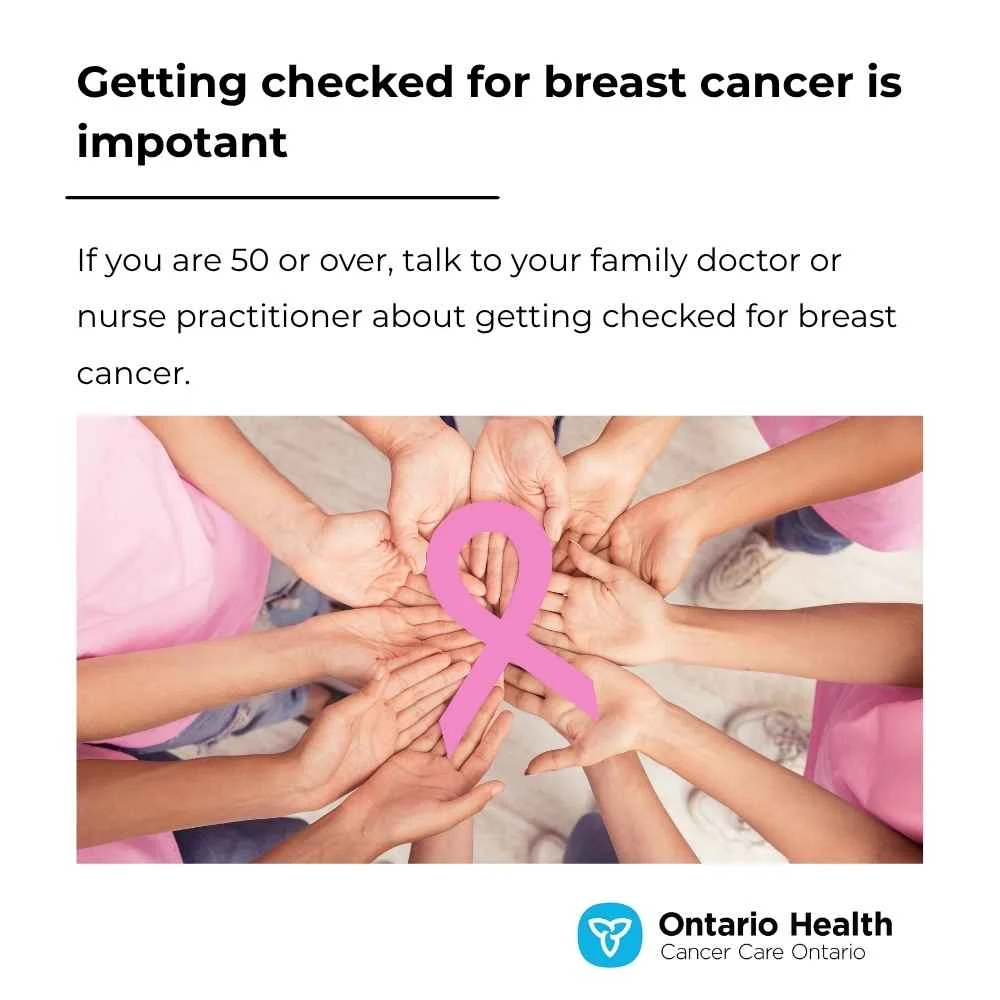
If you are ages 40 to 49, we encourage you to make an informed decision about whether to get screened for breast cancer. Talk with your family doctor, your nurse practitioner or a Health811 navigator about:
Visit cancercareontario.ca/breast to find your closest screening site and for more information about the Ontario Breast Screening Program. To book your mammogram, call 1.800.668.9304. A referral from a family doctor or nurse practitioner is not required.
Need this information in an accessible format?
1-877-280-8538, TTY 1-800-855-0511, info@ontariohealth.ca
Screening during pregnancy and lactation
Screening with mammography during pregnancy is safe and effective. If you do not want to get screened while you are pregnant, you can start screening 3 months after giving birth, even if you are still lactating.
Contact your family doctor or nurse practitioner if you notice any changes in your breasts (chest), such as a lump or redness that does not go away, or changes to your nipple. Also, the effects of pregnancy or breastfeeding can hide the symptoms of breast cancer or cause them to be overlooked, so it is important to be aware of them. Changes to the breast (chest) are not always caused by cancer, but they should be checked right away.
Guide To A Better
breast screening Experience
Mammogram Preparation
- If possible, obtain prior mammograms and make them available to the radiologist at the time of the current exam.
- Before scheduling a mammogram it is recommended that you discuss any new findings or problems in your breasts with your doctor. In addition, inform your doctor of any prior surgeries, hormone use, and family or personal history of breast cancer.
- Do not schedule your mammogram for the week before your period if your breasts are usually tender during this time. The best time to schedule is one week after your period. Always inform your doctor, radiologist, and x-ray technologist if there is any possibility that you are pregnant.
- Do not wear deodorant, talcum powder, or lotion under your arms or on your breasts on the day of the exam. These can appear on the x-ray film as “calcification”.
- Describe any breast symptoms or problems to the technologist performing the exam.
- Ask when your results will be available; do not assume the results are normal if you do not hear from your doctor.

Related links | More information on when to get screened
Cancer Care Ontario (CCO)
Breast cancer screening: https://www.cancercareontario.ca/en/types-of-cancer/breast-cancer/screening
Mammogram frequently asked questions:https://www.cancercareontario.ca/en/types-of-cancer/breast-cancer/screening/mammogram-faq
My CancerIQ: https://www.mycanceriq.ca/
The Ontario Breast Screening Program (OBSP) recommends that most women ages 40 to 74 get screened every two years with mammography.